What is A2P 10DLC, actually? (And why your texts aren't going through)
A fresh take that challenges the norm (and shows you a smarter way).
You signed up for HighLevel. You set up your sub-account, built your funnel, connected your calendar, plugged in your Twilio number, and tried to send your first welcome text.
Nothing.
Or worse — it sent, but the client never got it. Or it sent for a week and then stopped working. Or HighLevel popped up a message about "Trust Center" and "campaign registration" and "$20 brand fees" and you closed the tab because that wasn't the day for that.
Welcome to A2P 10DLC.
I'm going to explain what it actually is, why it exists, who it applies to, and what to do about it. In layman terms. No jargon-as-drama.
The short version
If software is sending text messages on your behalf to US phone numbers, you have to register your business with the carriers first. That registration is called A2P 10DLC. Without it, your texts get filtered, blocked, or silently dropped.
That's the whole thing.
The reason it feels confusing is that nobody tells you it exists until you're already mid-build, and the platforms that require it (HighLevel, Twilio, Quo, basically anyone) make the registration process feel like you're applying for a small business loan. You're not. You're just proving to AT&T, Verizon, and T-Mobile that you're a real business and the people you're texting actually agreed to be texted.
Why this exists
Spam.
That's the whole story.
You know those texts you get about your USPS package being held at the warehouse? Or your IRS refund pending acceptance within 24 hours? Or the random "hey is this still your number?" that's clearly trying to get you into a conversation with a scammer?
Carriers got tired of it. The FCC got tired of it. Customers got tired of it. So in 2023, the major US carriers (working with The Campaign Registry) said: enough. Anything sent to a phone from software now has to be registered. Real business, verified identity, documented opt-in process.
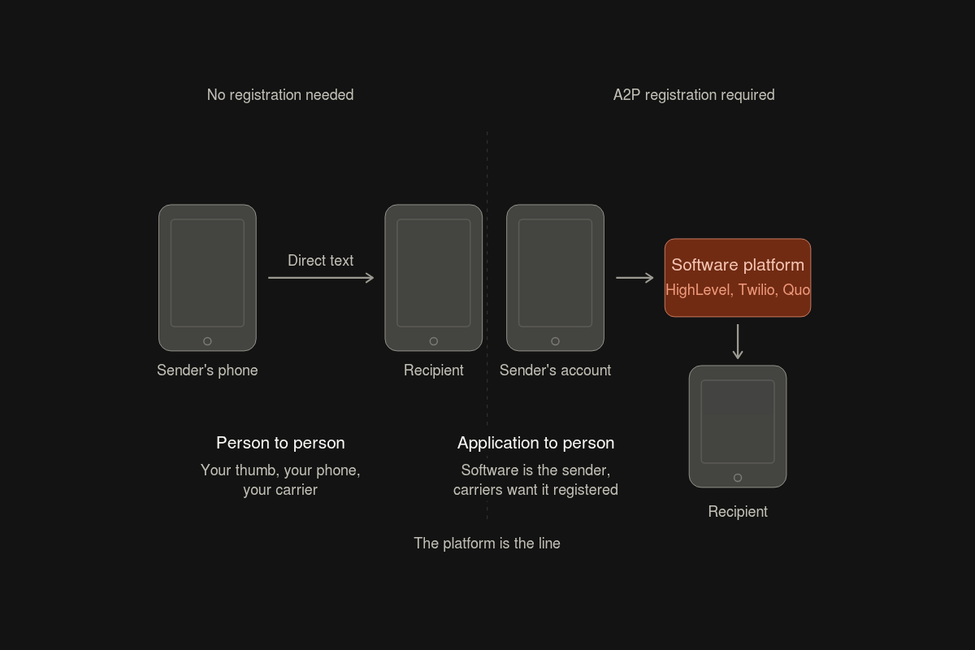
The dividing line that matters is this: software sending the text vs. a person sending the text.
Your thumb texting a client from your iPhone? Person-to-person. Not A2P. No registration needed.
The moment a software platform is the sender — HighLevel, Twilio, Klaviyo, Quo (formerly OpenPhone), any of them — it's application-to-person. That's where the "A2P" comes from. And that's the moment registration becomes required.
Who actually needs to register
If you're using HighLevel (or any similar platform) to send SMS to US phone numbers, you need to register. Not "should." Need. As of August 2023, unregistered numbers can't send to US recipients at all — the carriers block them at the network level.
A few clarifying cases I get asked about constantly:
"My client wants to use her personal iPhone for client texts." If she's literally hand-texting from her iPhone, no A2P. The moment she connects that number to a software app (Quo, OpenPhone, HighLevel, Google Voice for business), that app is the sender, and registration applies. Even if it's "just for her" — Quo's docs explicitly say there's no personal use exemption. Once the number lives inside their platform, the carriers see it as a virtual number, full stop.
"What if I just use HighLevel for the calendar and CRM, and use a different tool for the actual texting?" Whichever tool sends the text is where you register. If HighLevel only stores contacts and your texts go through Quo, you register through Quo. Some setups need both registrations because automated drips run through HighLevel and conversational texts run through OpenPhone — two senders, two registrations.
"What about toll-free numbers?" Different process called toll-free verification. Faster (sometimes 2 days), generally easier, and runs in parallel to A2P. If you need to send sooner than 4–6 weeks, toll-free is the bridge while your 10DLC registration is in review.
"What about Canadian numbers?" Not currently subject to A2P 10DLC. The rules are US-specific.
Why screen-recording tools are quietly hurting documentation
This is the part most "how to register" guides skip, and it's the part that determines whether you pass on the first try or burn $20 a pop on resubmissions.
There are three things being verified, in this order of weight:
One — is this a real business? Your Legal Business Name, EIN, and address get matched against IRS records. If your CP-575 (the IRS letter confirming your EIN) says "ABC INDUSTRIES LLC" in all caps and you submit "Abc Industries, LLC" with a comma — that's a fail. Not because the comma is illegal. Because string matching is exact.
Two — did the recipient actually opt in? They're checking your opt-in form, your privacy policy, your terms of service, and the consent language on your form. They're verifying the form is on a live public domain (not staging, not localhost), the consent checkbox is unchecked by default, and the language tells the user what they're signing up for. They will click the URL. They will read the privacy policy. If your privacy policy still says "we may share your data with affiliates" because you copy-pasted a generic e-commerce template, you fail — even if you don't actually share data.
Three — does what you say you'll send match what you actually plan to send? The text on your consent checkbox needs to match the message types in your campaign description. If your checkbox says "appointment reminders" but your campaign says "marketing messages," fail. The two have to align word-for-word about what messages the user is consenting to receive.
Every rejection traces back to one of these three. The 47 individual settings in the Trust Center are just how you prove each one.
The thing that catches everyone
Validators don't just check the URL you submit during registration. They check your whole domain.
Submit a clean opt-in page on app.yourbusiness.com? They'll also load yourbusiness.com to see if it's consistent. If your main domain has a different (non-compliant) privacy policy, or has forms without the consent checkboxes, or has LeadConnector-branded URLs visible — you fail.
This is the failure mode I see most often with HighLevel clients. The funnel page that gets submitted is squeaky clean. The main domain is a 2019 Squarespace site with a generic privacy policy that mentions "selling data to advertising partners." The validator sees the inconsistency and rejects.
So the real first move isn't building the opt-in page. It's auditing your whole web presence and making sure the story is consistent everywhere — same business name, same privacy policy, same compliant forms wherever a phone number is collected (including embedded calendar booking forms, which everyone forgets).
The pieces you actually need
Here's the full list. Treat this as the pre-flight checklist:
Documents on hand
CP-575 (or 147C if you lost the original) from the IRS
EIN that's at least 15 days old (new EINs auto-reject — IRS records haven't propagated yet)
Authorized Representative: real human, business email (not Gmail), direct phone (not Twilio)
Public assets, all live and consistent
Multi-page website on your own domain (no LeadConnector URLs)
Live opt-in page with two consent checkboxes — one for marketing, one for non-marketing — both unchecked by default, both optional
Privacy Policy with no "sharing/selling/affiliate" language about customer data
Terms of Service with the SMS-specific clauses
Both linked in the footer of the opt-in page
HighLevel configured
Custom fields for Marketing Consent and Non-Marketing Consent
Five compliance workflows (double opt-in, STOP, START, HELP, bad numbers)
Business Profile that matches the CP-575 character-for-character
A purchased phone number (not the HighLevel demo number)
That's the bar. None of it is hard individually. The trap is that all of it has to be true simultaneously before you submit, because the registration form references all of it, and the validator checks all of it.
How long this actually takes
If you have all the pieces ready and your CP-575 matches your Business Profile cleanly: maybe 2 hours of build time, plus 4–7 business days for review.
If you're starting from scratch with a single-page funnel site and a generic privacy policy: closer to 2 weeks of fixes before you should even think about hitting Submit.
If you skip the pre-flight and submit on vibes: $20 per failed submission, plus the time to figure out what went wrong, plus the rebuild, plus the resubmit. The math is brutal.
The whole point of having a real procedure for this is that you only do the rebuild once.
What you can't text about, ever
There are content categories that A2P will not approve regardless of how clean your registration is. T-Mobile started issuing what they call Sev-0 fines for these in 2024, and HighLevel passes those fines straight through to your account.
The forbidden list:
Cannabis, CBD, anything marijuana-adjacent (even in states where it's legal)
Debt consolidation, debt forgiveness, debt relief
High-risk financial services — payday loans, crypto signals, short-term high-interest lending
Hate speech or harassment
Lead gen via purchased lists or scraped data (any opt-in you can't document)
Gambling (except licensed state lotteries)
Firearms and ammunition
If your business is in one of these categories, A2P 10DLC isn't an option. You'd need to explore alternative channels — and honestly, most of these categories require legal counsel before you build a customer communication strategy at all.
After you're approved
A few things that aren't obvious:
You can send immediately after Brand and Campaign approval, but carrier propagation takes another 3 business days for all three major carriers (Verizon, AT&T, T-Mobile) to receive the registration. Some messages may fail in that window. This is normal and self-resolves.
Your Trust Score is set during Brand vetting. Higher score = more messages per second + higher T-Mobile daily limits. A low score usually means low public footprint — limited Google presence, no LinkedIn, no real digital footprint to verify. That's something you build over time, not fix in the registration.
Approval isn't permanent. Carriers monitor message traffic. If your opt-out rate goes above 2–3%, they flag the account. If your messaging drifts into prohibited content, they fine and throttle. Maintenance is part of the work, not a one-time event.
And — every automated SMS from your account needs "Reply STOP to unsubscribe" at the end, every first contact needs to identify your business by name, and you cannot text contacts who didn't check the consent box (even if they gave you their phone number on the same form). These rules are enforceable and tested.
The actual procedure
Everything above is the why. It's the context that helps you make decisions when something doesn't go to plan.
The actual how — the step-by-step procedure to get from "I need to register" to "Brand approved" — lives in a NextStep SOP I built specifically for this. It's structured as nine phases, eighty-something atomic steps, with the exact-language templates for everything you need to paste into the Trust Center along the way.
[Click Here to Complete the A2P Process With My SOP]
If you've read this far, the SOP is the part that saves you the $20 fees. The why is what helps you handle edge cases. Read this post once. Run the SOP every time.
TL;DR
A2P 10DLC is the carrier registration that lets your business send texts to US phone numbers from a software platform. It exists because of spam. Your iPhone doesn't need it. The second any platform is the sender, you do.
Three things get verified: that you're a real business (matched against IRS records), that your recipients really opted in (verified by clicking your opt-in URL and reading your privacy policy), and that what you say you'll send matches what your consent language says.
The most common failure is inconsistency between what you submit and what's live on your full web presence — main domain, subdomains, embedded forms, calendar pages. Audit everything before you submit.
If your business is in HighLevel and you're sending SMS to US numbers — yes, this applies. Run the SOP, follow the procedure, don't pay $20 per resubmission.
Thank you so much for reading!
Keep up the momentum with one or more of these next steps:
📣 Sharing helps spread the word, and you’ll look like a total genius when someone receives this blog recommendation from you. + Posts are formatted to be easy to read and share.
📲 Hang out with me on another platform. I’m on Instagram, Youtube, and Threads. Don’t be afraid to say hello if you hang out on any of those. DM me and say hello.